
·11 min read
7 days in Azerbaijan: Baku, Gabala, Sheki & Karabakh
A practical 7-day Azerbaijan itinerary covering Baku's Old City and Flame Towers, Gabala's nature, the craft town of Sheki, and Karabakh's Shusha.
A week is enough to see the best of Azerbaijan without rushing, if you structure it well. This itinerary pairs Baku's mix of old and new with the green mountains of Gabala, the craft heritage of Sheki, and a meaningful stretch in Karabakh. It's built around a sensible pace, with real travel days accounted for rather than glossed over.
Azerbaijan is often described as a crossroads of Europe and Asia, and this route is a compact tour of that idea: a UNESCO-listed medieval capital on the Caspian, forested mountains, a khan's town of painted palaces, and a highland city with deep cultural weight. Below is the day-by-day plan, followed by the practical planning notes (when to go, how to get around, and what to pack) that make it run smoothly.
Itinerary at a glance
| Day | Base | Focus |
|---|---|---|
| 1 | Baku | Old City (Icherisheher) |
| 2 | Baku | Modern Baku & the Caspian waterfront |
| 3 | Gabala | Travel day into the mountains |
| 4 | Gabala | Nature, cable car, waterfalls |
| 5 | Sheki | Khan's Palace & craft quarter |
| 6 | Shusha | Long travel day into Karabakh |
| 7 | Shusha | Shusha at a slow pace, then return |
Day 1: Baku's Old City
Start where the country's history is most concentrated. Spend the first day inside the walls of Icherisheher, the UNESCO-listed Old City, with the Maiden Tower and the Palace of the Shirvanshahs as anchors. Wander the lanes, settle in, and shake off the journey. It's the perfect gentle opening to the trip.
The walled core is compact and best explored on foot, the lanes, hammams, and caravanserai courtyards reward slow wandering more than a checklist. For a room-by-room sense of what's inside the walls, see our Icherisheher Old City guide.
Day 2: Modern Baku and the Caspian waterfront
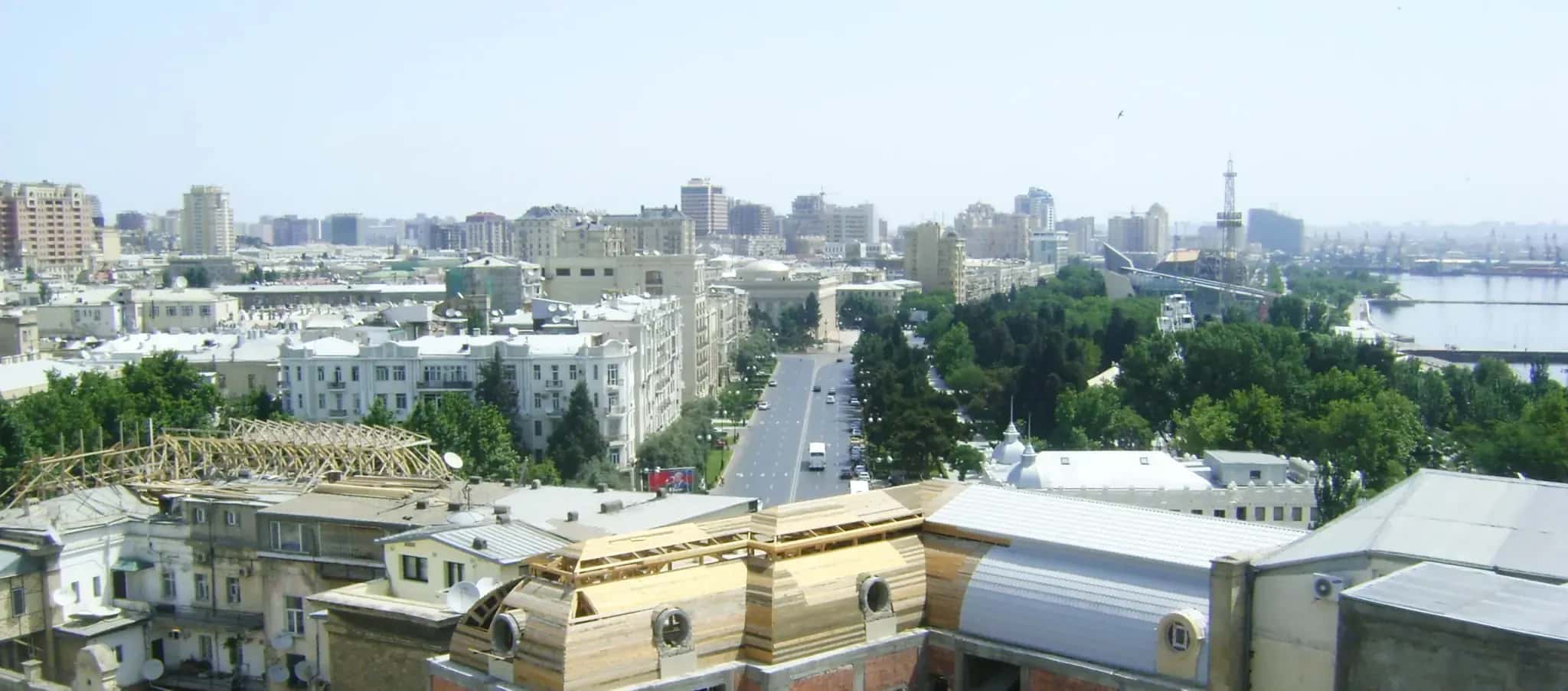
Day two is for the other side of Baku, the modern one. See the Flame Towers, walk the Caspian-side Boulevard, and visit the Heydar Aliyev Center, a landmark of contemporary architecture. This contrast between ancient and ultramodern is exactly what makes Baku memorable. For more on why the capital lands so well, see why visit Baku.
If you'd rather add a half-day trip on this stretch, the Absheron Peninsula is close: the Ateshgah fire temple and Yanar Dag burning hillside that gave Azerbaijan its "Land of Fire" name are an easy add. Two nights in Baku is the minimum this itinerary assumes; the city comfortably rewards a third if your dates allow.
Day 3: Travel to Gabala
Head into the mountains. The drive to Gabala trades the dry coast for greener, more elevated country. Arrive, settle in, and enjoy the change of air. Gabala is Azerbaijan's nature-and-resort hub, and it's a refreshing reset after two city days.
The route northwest runs through foothill country, so it's a scenic drive rather than dead time, a good day to break for a long lunch. Gabala is one of the country's older settlements, with a history stretching back to antiquity, and today it pairs that heritage with the country's best-known mountain resort scene. Our Gabala history and nature guide fills in the background.
Day 4: Gabala nature
Give Gabala a full day. Depending on the season and your interests, this is the place for cable-car views, forested hills, waterfalls, and mountain scenery. It's the most relaxed stretch of the week, and a deliberate one, because the pace picks up again afterward.
Because Gabala sits higher than the coast, it stays noticeably cooler, and the mountains hold snow into spring, worth remembering when you pack. This is also the natural point to slow down and eat well; the mountain towns are known for char-grilled meats, and a plate of fresh herbs and local cheese arrives with almost every meal.
Day 5: Sheki
Move on to Sheki, one of Azerbaijan's most atmospheric towns and a center of craft heritage. The star is the Sheki Khan's Palace, with its painted interiors and stained-glass shebeke windows. Explore the old caravanserai quarter and the bazaar, and take your time, Sheki is a town to absorb, not tick off.
The shebeke windows are built from many small hand-cut wood and coloured-glass pieces fitted together without nails or glue, a craft still practised in the town. Sheki is also the home of piti, a slow-cooked lamb and chickpea soup baked in a clay pot, best eaten where it's made; our what to eat in Azerbaijan guide covers it, and the Sheki Khan's Palace guide and Sheki bazaar guide go deeper on the sights and the market.
Day 6: Travel toward Karabakh and into Shusha
This is a long travel day toward Karabakh, and an important one. Karabakh is visited through an organized framework, so this part of the trip is structured rather than improvised. Arrive into the highland setting of Shusha and let the city's atmosphere land. Before fixing dates, confirm the current rules on official sources. See our Karabakh access rules guide.
Shusha sits high in the mountains and has long been regarded as a cradle of Azerbaijani music and poetry. Because the day covers real distance, it's the one most worth building around a comfortable, unhurried departure rather than an early scramble.
Day 7: Shusha and return
Give Shusha the unhurried time it deserves (its views, atmosphere, and cultural weight open up at a calmer pace) then begin the journey back. If Karabakh is a priority for you, it's easy to expand this section; our 3-day Karabakh itinerary shows how that block can grow.
When to go
Spring and autumn are the sweet spot for this route. April to June and September to October are generally comfortable across all four regions, with mild days and manageable travel conditions. Summer is warm and pleasant in the mountains around Gabala and Shusha but hot on the coast, while winter is mild in Baku and much colder, often snowy, in the highlands. Whatever your window, the mountains run cooler than the coast year-round, so plan clothing for both.
How to get around
Distances are longer than the map suggests, and the route strings together four regions, so this is a trip built around road travel between bases. Within Baku the historic core is walkable and the metro is cheap for longer hops, but the regional legs (Baku to Gabala, on to Sheki, and toward Karabakh) are best handled by a planned vehicle and driver, especially the long Karabakh day. Most visitors enter Azerbaijan on the ASAN Visa e-visa, applied for online before the trip; our Azerbaijan e-visa guide covers who needs one and how it works.
What to pack
- Layers. The mountains around Gabala and Shusha are cooler than coastal Baku, and evenings drop even in warm months.
- Comfortable walking shoes. The Old City lanes, Sheki's quarters, and Shusha's slopes all reward being on foot.
- Sun and rain cover. A light rain layer and sun protection both earn their place across a week that spans coast and highlands.
- Modest layers for cultural sites. Handy for mosques and traditional settings.
- Confirmation of your Karabakh arrangements. Keep your booking details and any required paperwork together for the Karabakh leg.
Practical tips
- Account for real travel days; Azerbaijan is bigger than it looks on a map.
- Confirm Karabakh access rules on official sources before locking dates.
- Pack layers, the mountains around Gabala and Shusha are cooler than coastal Baku.
- Build in a couple of slow meals; Azerbaijani food is a highlight, not a refueling stop.
- Keep one buffer for the unexpected rather than over-scheduling every hour.
How Pink Travel helps
We turn this outline into a real, bookable program, handling the routing, the long travel days, and the Karabakh logistics within the official framework. As a Baku-based operator, we run this route regularly and can adjust the pace to your group. Explore our Azerbaijan tours and Karabakh tours to see how it fits together.
FAQ
Is 7 days enough for Baku, Gabala, Sheki and Karabakh?
Yes, if the pace is realistic. This itinerary accounts for travel days and keeps each region to its essentials rather than over-packing the week.
Can I reorder the days?
Within reason, yes. The fixed point is that Karabakh is an organized, structured visit, so that part follows the official framework. The Baku-Gabala-Sheki sequence is flexible.
Do I need to arrange anything special for the Karabakh part?
Karabakh is visited through an organized framework. Confirm the current rules on official sources first.
When is the best time to do this trip?
Spring and autumn are generally comfortable across all four regions, but the mountains are cooler year-round. Tell us your travel window and we'll advise.
Can the trip be made shorter or longer?
Easily. The week can compress to a Baku-plus-Karabakh core or expand with more nature and Karabakh time. Share your priorities and we'll shape it.
How much time is spent traveling between regions?
A fair amount. This route covers real distance, and two of the seven days (into Gabala and into Karabakh) are primarily travel days. That's by design: we'd rather build in honest driving time than promise a pace that leaves you exhausted. The city and nature days are correspondingly relaxed.
Is this itinerary good for a first visit to Azerbaijan?
Yes. It's a strong first-timer's loop because it samples the country's main contrasts (a UNESCO capital, mountain nature, craft heritage, and Karabakh) without doubling back or sprinting. If you're weighing whether the country is for you, our reasons to travel Azerbaijan guide gives the wider picture.
Can we add more nature or a beach stretch?
Yes. Gabala can be extended for more hiking and mountain time, and the week can flex in either direction depending on your interests. Tell us what you're after and we'll shape the route around it.
Want this week built into a real, bookable trip? Message Pink Travel on WhatsApp with your dates and group size, and we'll turn the outline into a polished Azerbaijan itinerary.