
·9 min read
What to see in Shusha: a one-day walking route
What to see in Shusha in one day: fortress walls, Govhar Agha mosque, Bulbul and Natavan houses, Vagif mausoleum, Jidir Duzu, in a realistic walking order.
Shusha (also written Shushi, Şuşa, Шуша, Schuscha, Choucha or Szusza, depending on the language) is small enough to walk and rich enough to fill a whole day. The sights below are the ones most visitors build the day around, put in an order that makes geographic and emotional sense: walls first, then the mosques and the old streets, then the houses of the poets and singers, and finally the cliff-edge plateau for the afternoon light.
This is a checklist, not a promise. Shusha is still being restored, buildings close and reopen, and we have only included places we could confirm are real and part of the city today. Where something is uncertain, we say so.
Before you go: the practical frame
Foreign passport holders need an access request filed in advance for Karabakh, and it is the first thing to settle, well before you think about a route. Pink Travel files that request for guests who book a trip; the process is explained on our Karabakh permit page and in the access rules guide.
Shusha sits high on a plateau, so bring a layer even in summer, and wear shoes with grip: the walls, cobbles and viewpoints are uneven. For the longer picture of timing and seasons, see how to plan a Shusha trip.
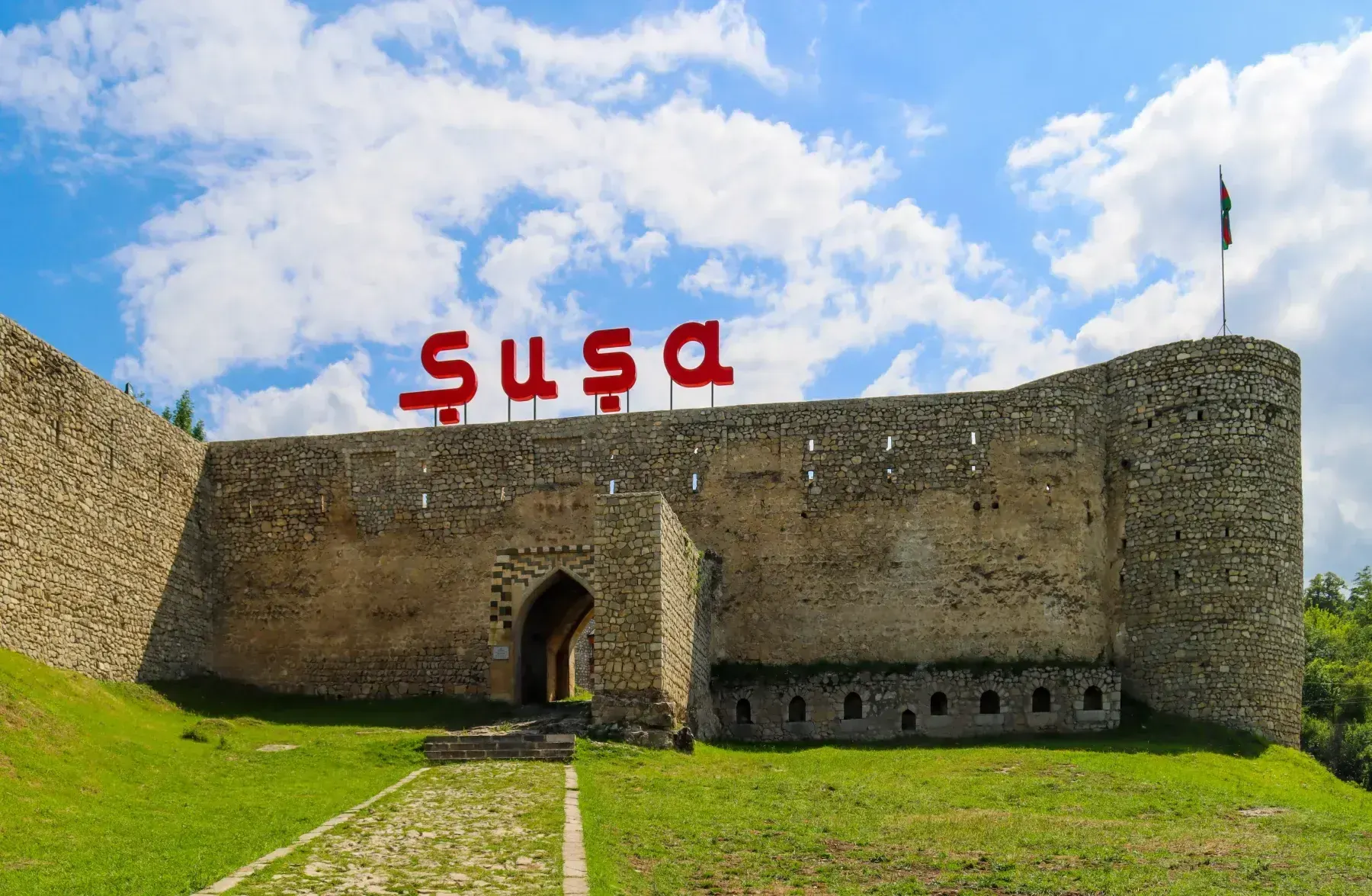
1. The fortress walls and the Ganja Gate (about 45 minutes)
Start where the city starts. Shusha was founded in the mid-18th century by Panahali Khan as the fortified capital of the Karabakh khanate, and the walls and gates are the frame for everything else. The best known is the Ganja Gate. Conservation work on the gate and the damaged stretches of wall has been carried out in stages, including restoring the "Shusha" inscription on the walls, so you will see old stone next to fresh repair.
Do not expect a single castle with a ticket booth: this is a whole fortified town, read best on foot. Our Shusha fortress history explains what you are looking at, and it is worth skimming before you arrive.
2. The Govhar Agha mosques (about 45 minutes)
Shusha has two mosques named after Govhar Agha, the daughter of Ibrahim Khan. The Yukhari (Upper) Govhar Agha mosque, with its twin minarets and tall silhouette, is the one in most photographs of the city. It was reopened after reconstruction in May 2023. The Ashaghi (Lower) mosque, the earlier of the two, was inaugurated after restoration in July 2024.
Visitors should dress modestly and be ready to remove shoes where entry is allowed. Prayer times and works can limit access, so treat interior visits as a bonus rather than a guarantee.
3. The old streets and the caravanserai quarter (about 45 minutes)
Between the mosques and the central square you pass what remains of the old merchant town. Nineteenth-century Shusha had a number of caravanserais, and some have been restored: the Heydar Aliyev Foundation completed the restoration of one built in the 1880s on the main trade street, Rasta Bazaar. Whether a particular building is open as a shop, cafe or exhibit changes, so the pleasure here is the street itself: stone facades, carved balconies, the sense of a trading city.
4. The Ghazanchetsots cathedral (about 15 minutes from outside)
The Holy Saviour (Ghazanchetsots) cathedral is the largest church in town and a major landmark; it was completed in 1887 for Shusha's Armenian community. It was damaged in 2020, and its restoration since then is described in sharply different ways by Azerbaijani and Armenian sources, with no international inspection that we could find. We include it because it dominates the skyline and visitors ask about it. We cannot confirm whether it is open inside on a given day, so plan on seeing it from outside and ask your guide on the day.
5. The three bullet-scarred busts (about 30 minutes)
Bronze busts of the poet Khurshidbanu Natavan, the poet and vizier Molla Panah Vagif and the singer Bulbul were shot at, taken away to be scrapped, intercepted in Georgia and kept unrepaired in Baku before returning to Shusha. Their scars were left visible on purpose. Of everything in town they tend to stay with visitors longest; the full story is in our guide to the bullet-scarred busts.
6. Bulbul's house-museum (about 40 minutes)
Bulbul (1897-1961), the tenor who helped found professional vocal art in Azerbaijan, was born in Shusha. His family house became a museum, and after being damaged and emptied during the occupation it was reopened after renovation in August 2021, with a new exposition and a bust in the yard. It is the best place to connect the city to its mugham tradition: pair it with our guide to Shusha's music heritage.
7. Natavan's house and the Khan Gizi spring (about 40 minutes)
Khurshidbanu Natavan (1832-1897), the last khan's daughter, was a lyric poet and a philanthropist. The spring known as Khan Gizi (the "khan's daughter"), built in 1873 with her funds to bring mountain water to the city, has been restored and is an easy, pleasant stop. Her house was turned into a museum in 1987 and was damaged afterwards. We could not confirm a current visiting arrangement for the interior, so check with your guide before promising yourself a tour inside.
8. The Vagif mausoleum and Jidir Duzu (about 60-90 minutes)
Save the cliff edge for later in the day. The Vagif mausoleum, raised in 1982 on the height where the poet is buried, looks out over Jidir Duzu, the "racing plain" of Karabakh horses, festivals and songs. It is the most spacious, quietest part of the visit and the best place to watch the light change. Read the stories first in our Vagif mausoleum guide and the guide to Jidir Duzu and Topkhana. Depending on where you have parked, this end of the town is often easier by a short drive than on foot after a full day.
9. Topkhana and the Khari Bulbul fields (flexible)
The Topkhana forest below the plateau adds shade and green, and in late spring the small Khari Bulbul orchid, Shusha's emblem, blooms on the slopes around the city. It is a seasonal bonus, not a fixed stop: if you come in May you may catch it, and Shusha also holds the Khari Bulbul music festival around that time. See the Khari Bulbul guide for how it became a symbol.
How much time do you need
Counting walking, a coffee and a proper lunch, the whole list is a full day of roughly seven to nine hours on the ground, on top of the long drive from Baku. If you want to do it without watching the clock, give Shusha its own day, or split it over two. If time is short, drop the cathedral and the caravanserai, and keep the walls, a mosque, the busts, one house-museum and the Vagif mausoleum with Jidir Duzu.
Plan the trip around a guide who knows the layout: it saves time on the stretches that are better driven, and on days when a building is closed for works it helps to have a plan B. See our Karabakh tours for ready-made routes.
FAQ
What are the main things to see in Shusha?
The fortress walls and Ganja Gate, the Govhar Agha mosques, the old streets and caravanserai quarter, the bullet-scarred busts, Bulbul's house-museum, Natavan's house and spring, the Vagif mausoleum and Jidir Duzu.
How long do you need in Shusha?
A full day, roughly seven to nine hours on the ground, is comfortable. You can see the highlights in half a day, but you will choose between the cultural sights and the views.
Is Shusha worth visiting?
Yes, if you care about history, music and landscape: it is the historic capital of the Karabakh khanate and the cradle of mugham, with a plateau setting that few cities match.
Is the Ghazanchetsots cathedral open to visitors?
We cannot confirm that. It is a prominent landmark you can see from outside, and its restoration is described differently by different sources. Ask your guide on the day.
When do the Khari Bulbul flowers bloom?
Late spring, usually around May. The timing varies with the year and the altitude.
Do I need a permit to visit Shusha?
Foreign passport holders need an access request filed in advance. Pink Travel files it for guests; see the permit page.
Want this route built around your dates? Message Pink Travel on WhatsApp and we will plan Shusha with the right amount of time.
Plan Your Karabakh Trip
The main Karabakh planning pages in one place
The hub, tours page, Shusha page, and key guides are grouped together so readers can build context before making a travel decision.
For a long time, Karabakh was mostly known from a distance. Now Shusha, changing access rules, and rebuilding tourism infrastructure are turning it into a destination people can plan with more intention.
Shusha-led routes of one to three days, your entry permit filed for you, and a firm per-person price before you commit to anything.
Why the official Karabakh permit portal won't work for you