
·9 min read
Gobustan: 40,000 years of rock art near Baku
Gobustan National Park near Baku, a UNESCO rock-art landscape of ancient petroglyphs and the Gaval Dash musical stone, and how to visit.
An hour south of Baku, a rocky hillside holds one of the oldest art galleries on Earth. Gobustan is a landscape carved with tens of thousands of images left by people over many millennia, a UNESCO World Heritage site where prehistory is written directly onto the stone. For travelers who want depth beyond the modern skyline, it is one of the most rewarding day trips in Azerbaijan, and one we build into itineraries again and again.
What Gobustan is
Gobustan is an open-air rock-art reserve where ancient inhabitants engraved petroglyphs (images of people, animals, hunting scenes, dancers and boats) across cliffs and boulders. The carvings span an enormous stretch of time, offering a rare continuous record of human life in the region. UNESCO inscribed the Gobustan Rock Art Cultural Landscape on the World Heritage List for exactly this reason.
The name comes from the local words for a "ravine-cut" terrain, and that is what you find: a boulder-strewn plateau of pale limestone rising from the semi-desert between the Caspian shore and the low Greater Caucasus foothills. The rock here is soft enough to carve yet durable enough to hold an image for thousands of years, which is a large part of why so much survives.
Reading the carvings
The images are more than decoration. Rows of dancing figures, hunters with bows, and boats with sun symbols hint at the beliefs, economy and rituals of the people who made them. A well-designed visitor center helps decode what you are looking at, turning a hillside of scratches into a readable story of prehistory.
Look closely and the scenes start to connect. There are long-horned bulls and wild goats, women and men rendered in a distinctive local style, and reed boats that many read as a sign the Caspian once lay closer to the site. One often-cited detail is a short Latin inscription left by a Roman legion that reached this far east, a reminder that the site was within reach of the ancient world's long-distance routes. A guide, or the center's own displays, makes the difference between glancing at marks and actually reading them.
The Gaval Dash musical stone
Gobustan holds a famous curiosity: the Gaval Dash, a large flat stone that rings with a tambourine-like tone when struck in different places. It is often described as a natural musical instrument used in ancient times, a reminder that the site was about sound and ceremony, not only images. Tap it in one spot and it sounds hollow and deep; move a hand-span along and the pitch changes. It is the kind of small, human detail that makes prehistory feel suddenly close.
Mud volcanoes nearby
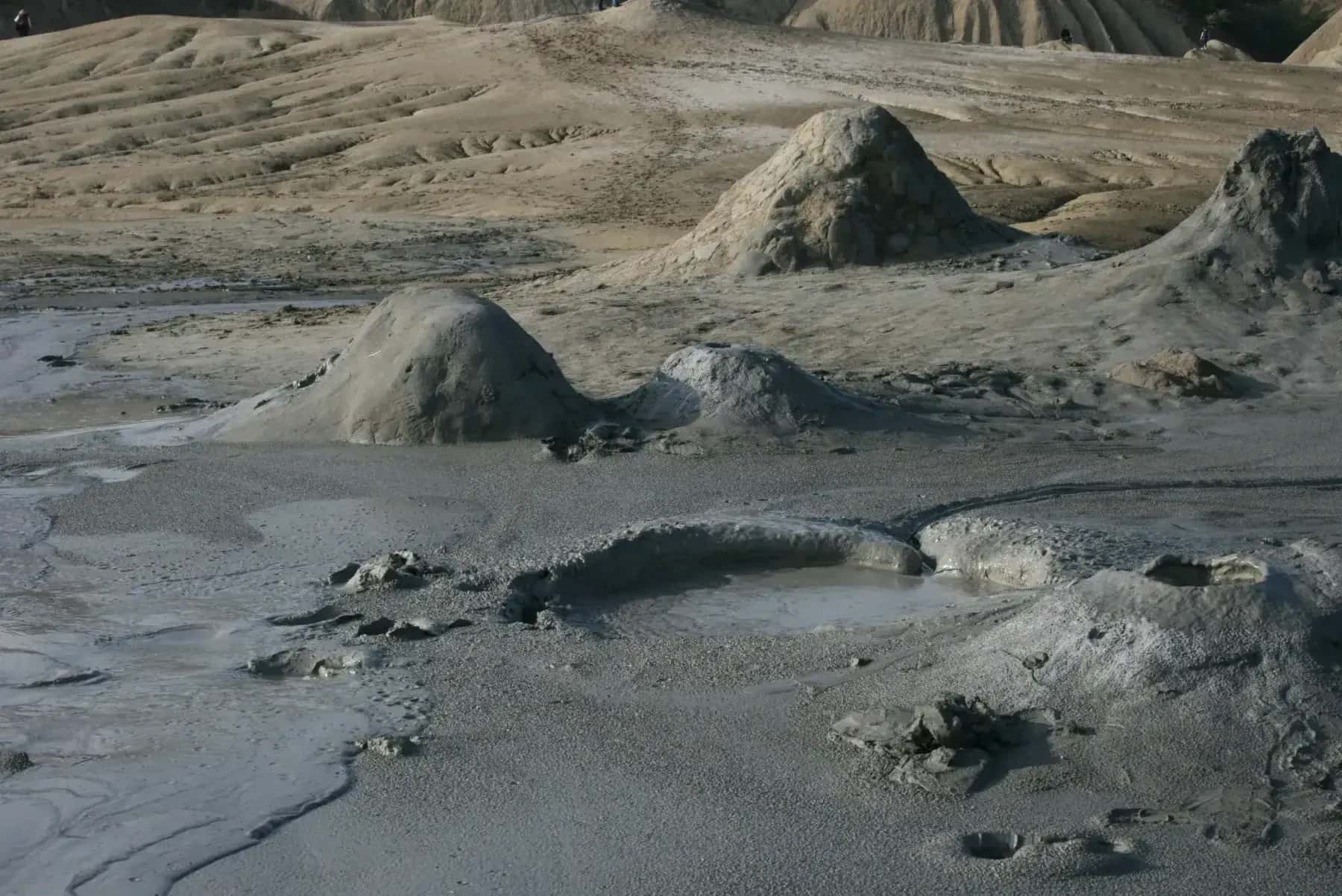
The Gobustan area is also known for its mud volcanoes, bubbling cones of cool grey mud that make for a genuinely otherworldly landscape. Azerbaijan has one of the highest concentrations of them in the world, and they pair naturally with a rock-art visit.
Unlike the fiery volcanoes most people picture, these are cold: the mud is at roughly ambient temperature, pushed up by underground gas rather than heat, so it is safe to stand beside the gurgling cones and watch them plop and hiss. The field sits a short drive from the main petroglyph reserve, often over rougher unpaved track, which is one reason many visitors fold it into a guided trip rather than driving it alone. The pairing of the two (ancient carvings on the ridge, alien grey mudscape below) is what turns Gobustan from a single sight into a proper half-day out.
The bigger picture: Azerbaijan's "Land of Fire"
Gobustan makes most sense alongside the other things that make this corner of Azerbaijan geologically strange. The same underground gas that feeds the mud volcanoes also feeds the natural flames that gave the country its "Land of Fire" nickname, the eternal fire of Yanar Dag and the Ateshgah fire temple on the nearby Absheron Peninsula. Seeing rock art, mud volcanoes and burning hillsides in a day or two gives you the deep, elemental side of Azerbaijan that the glass towers of the capital never hint at. For the case on the city itself, see why visit Baku.
How to visit
Gobustan is an easy half-day or day trip from Baku and combines well with the fire sights covered in Ateshgah and Yanardag. It lies roughly an hour south of the city along the Caspian coast, so it is comfortable to see the petroglyphs, the museum and the mud volcanoes and be back in Baku by afternoon.
A few practical notes we give our travelers:
- How long: allow two to three hours at the reserve and museum, plus travel and an optional detour to the mud volcanoes. A relaxed half-day covers it; a full day lets you pair it with Absheron.
- Best season: spring (April–June) and autumn (September–October) are the most comfortable, with mild temperatures and good light on the carvings. Summer is hot and shadeless on the open hillside, and winter can be windy off the Caspian, so bring layers.
- What to bring: sturdy closed shoes for uneven rock and gravel, sun protection, water, and a little cash for entry and the mud-volcano track. The terrain is easy but not smooth.
- Getting there: the simplest options are a guided day trip or a hired car with driver; the mud-volcano approach in particular is rough and better handled by someone who knows it. Public transport gets you close to the town but not neatly to the sites.
Gobustan slots naturally into a wider loop of the country. See how a full route hangs together in our 7-day Azerbaijan itinerary, or plan the capital first with our Baku Old City guide.
Which official signals support this
- UNESCO lists the Gobustan Rock Art Cultural Landscape as a World Heritage site
FAQ
What is Gobustan?
Gobustan is a UNESCO World Heritage rock-art landscape near Baku, where ancient people carved tens of thousands of petroglyphs into cliffs and boulders over many millennia.
What is the Gaval Dash?
The Gaval Dash is a large flat "musical stone" at Gobustan that produces tambourine-like tones when struck, thought to have been used in ancient ceremonies.
Are the mud volcanoes part of Gobustan?
The Gobustan area is famous for its mud volcanoes, cool bubbling cones of grey mud, which are commonly combined with a rock-art visit.
How do I get there?
Gobustan is about an hour south of Baku and works as a half-day or day trip. Message us and we'll build it into an itinerary.
How long should I spend at Gobustan?
Plan two to three hours for the petroglyph reserve and its museum, plus travel time from Baku and an optional detour to the mud volcanoes. As a half-day trip it stands on its own; with a full day you can pair it with the Absheron fire sights.
When is the best time to visit Gobustan?
Spring and autumn are ideal, mild temperatures and clear light make the carvings easier to see and the open hillside more comfortable to walk. Summer is hot with little shade, and winter can be windy off the Caspian, so dress for the season and bring layers.
Is Gobustan suitable for families or older travelers?
Broadly yes. The main petroglyph trails are short and the museum is modern and accessible, so most visitors manage them easily. The ground is uneven rock in places and the mud-volcano track is rough, so closed shoes help and anyone with limited mobility may prefer to skip that final leg.
Can I combine Gobustan with other sights in one day?
Yes. It pairs especially well with the Absheron Peninsula's fire temple and burning hillside, since both are day trips out of the capital and both show off Azerbaijan's geology. A guided trip is the easiest way to link them without doubling back.
Want to see Azerbaijan's prehistory up close? Message Pink Travel on WhatsApp with your dates. Explore our tours or reach out via our contact page.