
·9 min read
A monuments walking route through Baku: statues, poets and memory
A self-guided walking route through Baku's monuments and statues, Nizami Square, the Museum of Literature and more, with the history behind each stop.
You can learn a surprising amount about Azerbaijan just by walking central Baku and paying attention to who stands on the pedestals. The city's monuments are not tucked away in a sculpture park. They are woven into squares and streets people cross every day. This route strings the best of them together into a walk you can do in an afternoon, and it doubles as a low-effort introduction to how the country sees itself: a place that puts its poets, not its generals, on the tallest plinths.
We build this walk into a lot of first days in Baku, because it moves you gently from the modern center into the medieval Old City while giving each stop a story. Below is the route, the history behind the main monuments, and the practical notes (when to go, how long it takes, what to bring) to do it well on your own.
Start at Nizami Square
Begin at the Nizami Ganjavi statue in Nizami Square. Unveiled in 1949 and created by sculptor Fuad Abdurahmanov, it is a roughly 6-meter bronze on a tall pedestal, a fixed landmark locals use to orient themselves. It sets the theme for the whole walk: in Baku, the poet comes first.
Nizami Ganjavi was a 12th-century poet whose long romantic epics are among the most celebrated works in the Persian literary tradition, and Azerbaijan honors him as a national figure. It's worth pausing at the base of the statue rather than just photographing it from across the square. For the poet's full story, see the Nizami mausoleum guide, which covers the memorial to him in the city of Ganja.
The square itself is a good place to get your bearings before setting off. It sits at the edge of the pedestrian shopping street and the busier downtown, so you have cafés and shade close by for a coffee before the walk.
The Museum of Literature
A short walk away, the Nizami Museum of Azerbaijan Literature carries sculptures of major national poets on its facade, an entire literary canon rendered in stone above the street. It is the clearest single statement of how Azerbaijan ranks its cultural figures: the building that houses the country's literary heritage wears its greatest writers on the outside, at eye level, for everyone passing to see.
Take a minute here to look up and read the figures across the facade rather than hurrying past. This is the emotional center of the whole walk, the idea that a nation's memory can be built around its writers is easier to feel standing under these statues than to read about.
Poets and cultural figures across the center
From there, central Baku is dotted with monuments to writers, composers and thinkers. Rather than a rigid list, treat this stretch as a theme: notice how often the honored figure is an artist rather than a soldier. That pattern is the real lesson of the walk, and it connects directly to the guide to Azerbaijan's monuments.
As you wander, you'll pass composers who shaped Azerbaijani classical music, playwrights, and poets whose names recur on streets and metro stations across the city. You don't need to identify every one. The point is the cumulative impression, a downtown that keeps choosing to commemorate the people who wrote, composed, and taught. Read each figure you stop at with three questions: who is this, when were they raised here, and in what spirit. That habit turns a row of statues into a short history lesson.
Toward the Old City
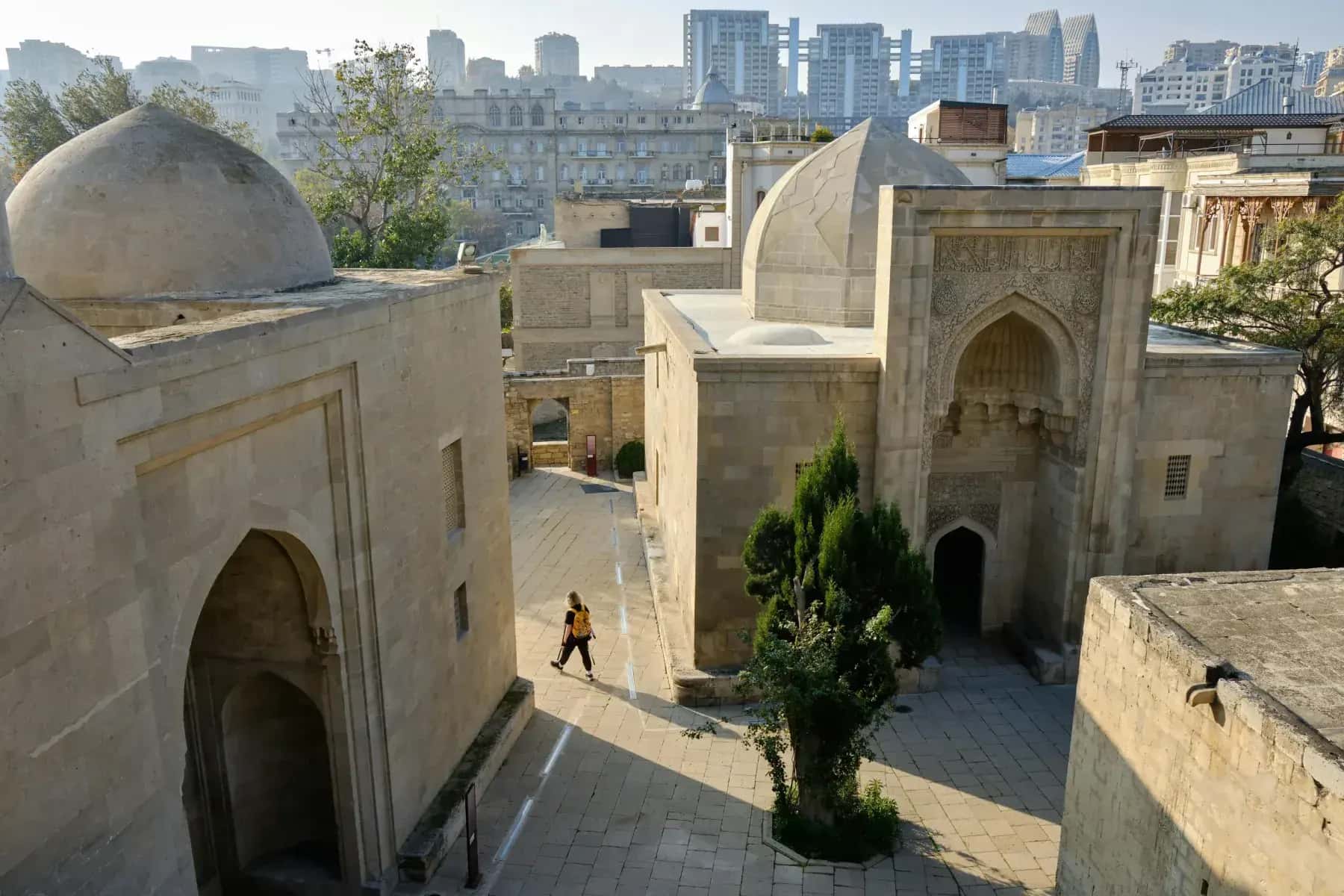
The route naturally drifts toward Icherisheher, the walled Old City, where the Maiden Tower and Palace of the Shirvanshahs shift the story from modern statuary to medieval architecture. It is a clean handoff from "who Baku honors" to "how old Baku is."
The Old City is a UNESCO World Heritage Site and rewards slow wandering: narrow lanes, carved stone, small carpet and craft shops, and courtyards that open unexpectedly off the main streets. It's the natural place to end the walk and settle in for lunch or tea. If you want to go deeper here, our Icherisheher Old City guide covers the Maiden Tower, the Shirvanshahs' palace, and how to read the walls. For the wider case on the capital, read why visit Baku.
How to walk it well
- Go on foot; the monuments are close together and the walk is the point.
- Read each figure with the three questions: who, when raised, and in what spirit.
- Let the theme, poets over generals, do the interpreting for you.
- Start earlier in the day if it's warm, so you finish in the shade of the Old City lanes.
- Leave time at the end; the Old City deserves more than a quick loop.
Planning the walk: season, timing and what to bring
How long it takes. An afternoon is plenty for an unhurried pace, finishing near or inside the Old City. If you stop into the Museum of Literature or linger in Icherisheher, treat it as a half-day.
Best season. Spring and autumn are the most comfortable months to walk Baku, mild and pleasant. Summers can be hot and famously windy, so an early start and water help; winters are mild but breezy off the Caspian, so a jacket is worth having. For a fuller seasonal picture of the capital, see why visit Baku.
What to bring. Comfortable shoes are the main thing, much of the Old City is cobbled. Bring water in warm weather, sun cover, and a light layer for the sea breeze. The whole route is central and walkable, so you won't need transport between stops.
Where it fits. This walk pairs neatly with a day in the Old City and an evening on the Boulevard, and it slots easily into the first day of a longer trip. See how the city anchors a wider route in our 7-day Azerbaijan itinerary.
Which official signals support this
- the Nizami statue and Museum of Literature are long-standing, documented public monuments in central Baku
FAQ
Where does the Baku monuments walk start?
At the Nizami Ganjavi statue in Nizami Square, a 1949 bronze by Fuad Abdurahmanov that serves as a central orientation point.
What is the Museum of Literature?
The Nizami Museum of Azerbaijan Literature, whose facade carries sculptures of major Azerbaijani poets. It is one of the clearest expressions of the country's literary self-image.
How long does the route take?
An afternoon is enough to walk the core monuments at an unhurried pace and finish near the Old City. Add museum stops or Old City time and it becomes a relaxed half-day.
When is the best time of day and year to do it?
Spring and autumn are the most comfortable seasons. On warmer days, start earlier so you finish in the cooler, shaded lanes of the Old City rather than the exposed squares at midday.
Is the walk suitable for families or older travelers?
Yes. It's flat and central, with cafés and benches along the way. The one thing to note is that the Old City streets are cobbled, so steady shoes matter more than fitness.
Do I need a guide?
You can do it self-guided with this route, but a guide adds the stories behind each figure. Message us if you'd like the walk led.
Want Baku's monuments explained as you walk them? Message Pink Travel on WhatsApp with your dates. Explore our tours or reach out via our contact page.